Documents · Family Letters & Memories
A Letter from Saba to Yaniv Yosef
In this letter, Leo Habel (“Saba”) writes to his grandson Yaniv Yosef about the great-grandfather for whom Yaniv was named, Yoseph Meir. Leo reflects on immigrant life, Jewish community responsibility, family sacrifice, and the importance of carrying Jewish values from one generation to the next.
Why this letter matters
The letter connects four generations of the family and preserves Leo’s memories of his father’s role in the Kitiver benevolent community in New York. It also records Leo’s reflections on balancing responsibility to family with service to the wider community.
People in this letter
- Leo Habel (“Saba”)
- Writer
- Yaniv Yosef (“Niv”)
- Grandson
- Yoseph Meir
- Leo’s father and Yaniv’s great-grandfather
Original document
Transcription
Leo’s original wording, spelling and Hebrew/Yiddish expressions are preserved as written.
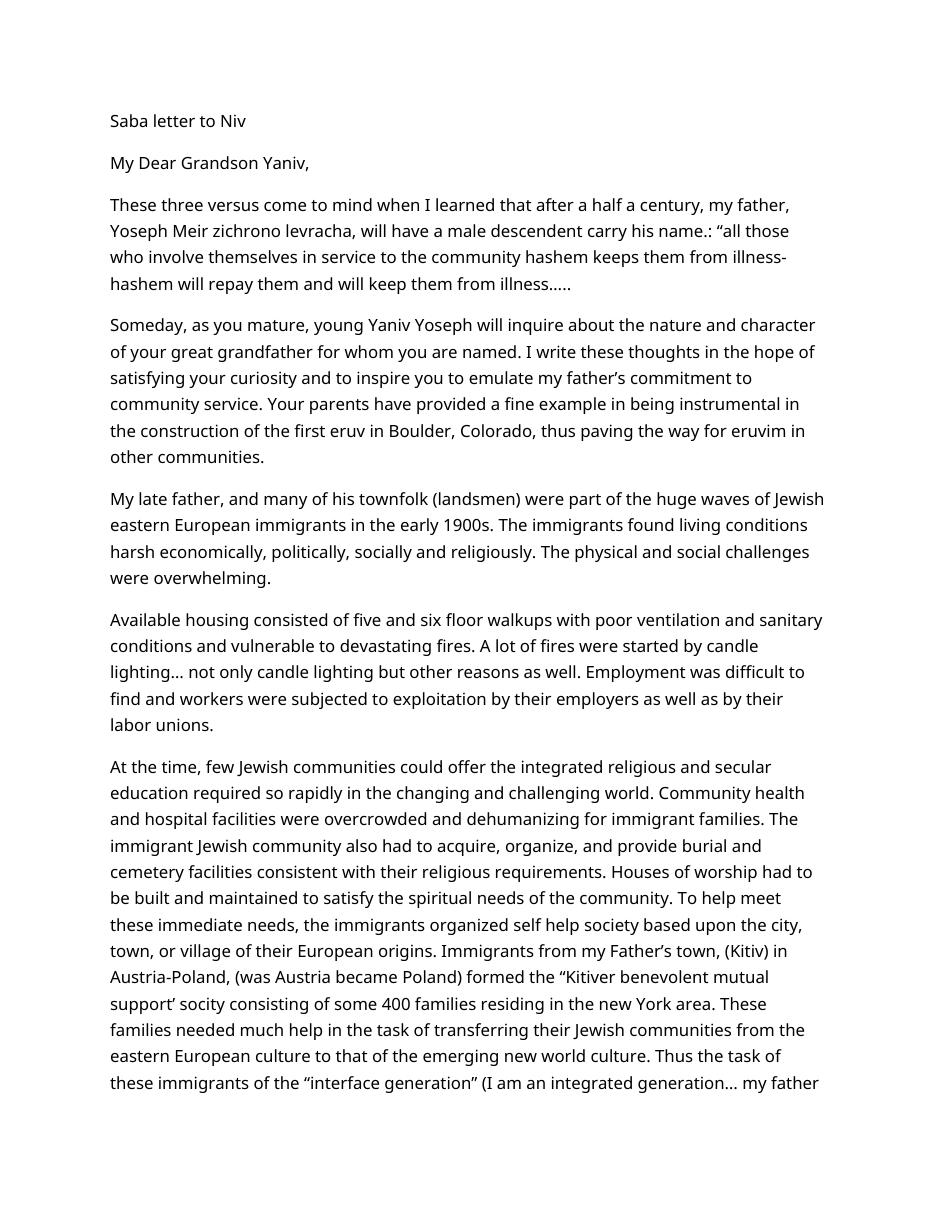
Saba letter to Niv
My Dear Grandson Yaniv,
These three versus come to mind when I learned that after a half a century, my father, Yoseph Meir zichrono levracha, will have a male descendent carry his name.: “all those who involve themselves in service to the community hashem keeps them from illness- hashem will repay them and will keep them from illness…..
Someday, as you mature, young Yaniv Yoseph will inquire about the nature and character of your great grandfather for whom you are named. I write these thoughts in the hope of satisfying your curiosity and to inspire you to emulate my father’s commitment to community service. Your parents have provided a fine example in being instrumental in the construction of the first eruv in Boulder, Colorado, thus paving the way for eruvim in other communities.
My late father, and many of his townfolk (landsmen) were part of the huge waves of Jewish eastern European immigrants in the early 1900s. The immigrants found living conditions harsh economically, politically, socially and religiously. The physical and social challenges were overwhelming.
Available housing consisted of five and six floor walkups with poor ventilation and sanitary conditions and vulnerable to devastating fires. A lot of fires were started by candle lighting… not only candle lighting but other reasons as well. Employment was difficult to find and workers were subjected to exploitation by their employers as well as by their labor unions.
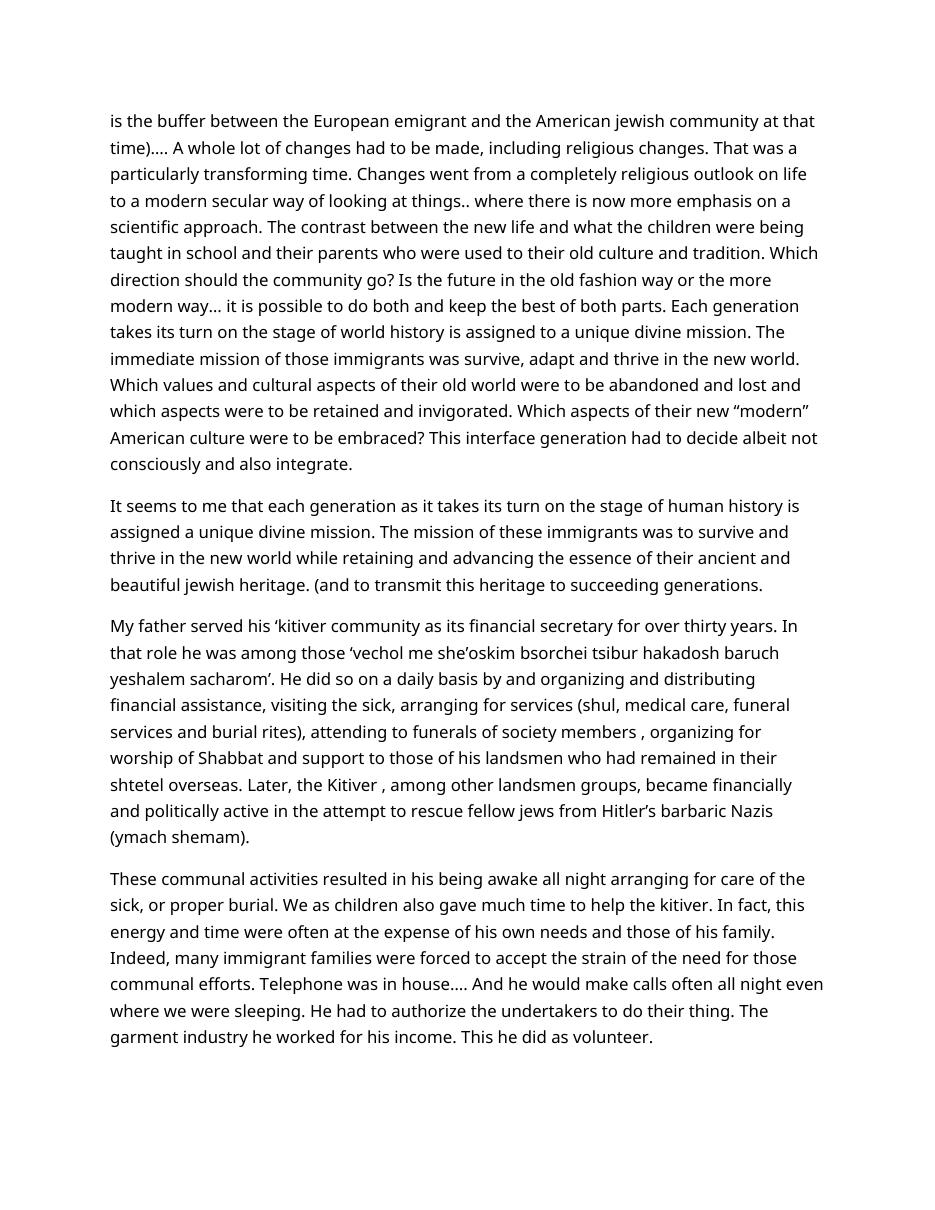
At the time, few Jewish communities could offer the integrated religious and secular education required so rapidly in the changing and challenging world. Community health and hospital facilities were overcrowded and dehumanizing for immigrant families. The immigrant Jewish community also had to acquire, organize, and provide burial and cemetery facilities consistent with their religious requirements. Houses of worship had to be built and maintained to satisfy the spiritual needs of the community. To help meet these immediate needs, the immigrants organized self help society based upon the city, town, or village of their European origins. Immigrants from my Father’s town, (Kitiv) in Austria-Poland, (was Austria became Poland) formed the “Kitiver benevolent mutual support’ socity consisting of some 400 families residing in the new York area. These families needed much help in the task of transferring their Jewish communities from the eastern European culture to that of the emerging new world culture. Thus the task of these immigrants of the “interface generation” (I am an integrated generation… my father is the buffer between the European emigrant and the American jewish community at that time)…. A whole lot of changes had to be made, including religious changes. That was a particularly transforming time. Changes went from a completely religious outlook on life to a modern secular way of looking at things.. where there is now more emphasis on a scientific approach. The contrast between the new life and what the children were being taught in school and their parents who were used to their old culture and tradition. Which direction should the community go? Is the future in the old fashion way or the more modern way… it is possible to do both and keep the best of both parts. Each generation takes its turn on the stage of world history is assigned to a unique divine mission. The immediate mission of those immigrants was survive, adapt and thrive in the new world. Which values and cultural aspects of their old world were to be abandoned and lost and which aspects were to be retained and invigorated. Which aspects of their new “modern” American culture were to be embraced? This interface generation had to decide albeit not consciously and also integrate.
It seems to me that each generation as it takes its turn on the stage of human history is assigned a unique divine mission. The mission of these immigrants was to survive and thrive in the new world while retaining and advancing the essence of their ancient and beautiful jewish heritage. (and to transmit this heritage to succeeding generations.
My father served his ‘kitiver community as its financial secretary for over thirty years. In that role he was among those ‘vechol me she’oskim bsorchei tsibur hakadosh baruch yeshalem sacharom’. He did so on a daily basis by and organizing and distributing financial assistance, visiting the sick, arranging for services (shul, medical care, funeral services and burial rites), attending to funerals of society members , organizing for worship of Shabbat and support to those of his landsmen who had remained in their shtetel overseas. Later, the Kitiver , among other landsmen groups, became financially and politically active in the attempt to rescue fellow jews from Hitler’s barbaric Nazis (ymach shemam).
These communal activities resulted in his being awake all night arranging for care of the sick, or proper burial. We as children also gave much time to help the kitiver. In fact, this energy and time were often at the expense of his own needs and those of his family. Indeed, many immigrant families were forced to accept the strain of the need for those communal efforts. Telephone was in house…. And he would make calls often all night even where we were sleeping. He had to authorize the undertakers to do their thing. The garment industry he worked for his income. This he did as volunteer.
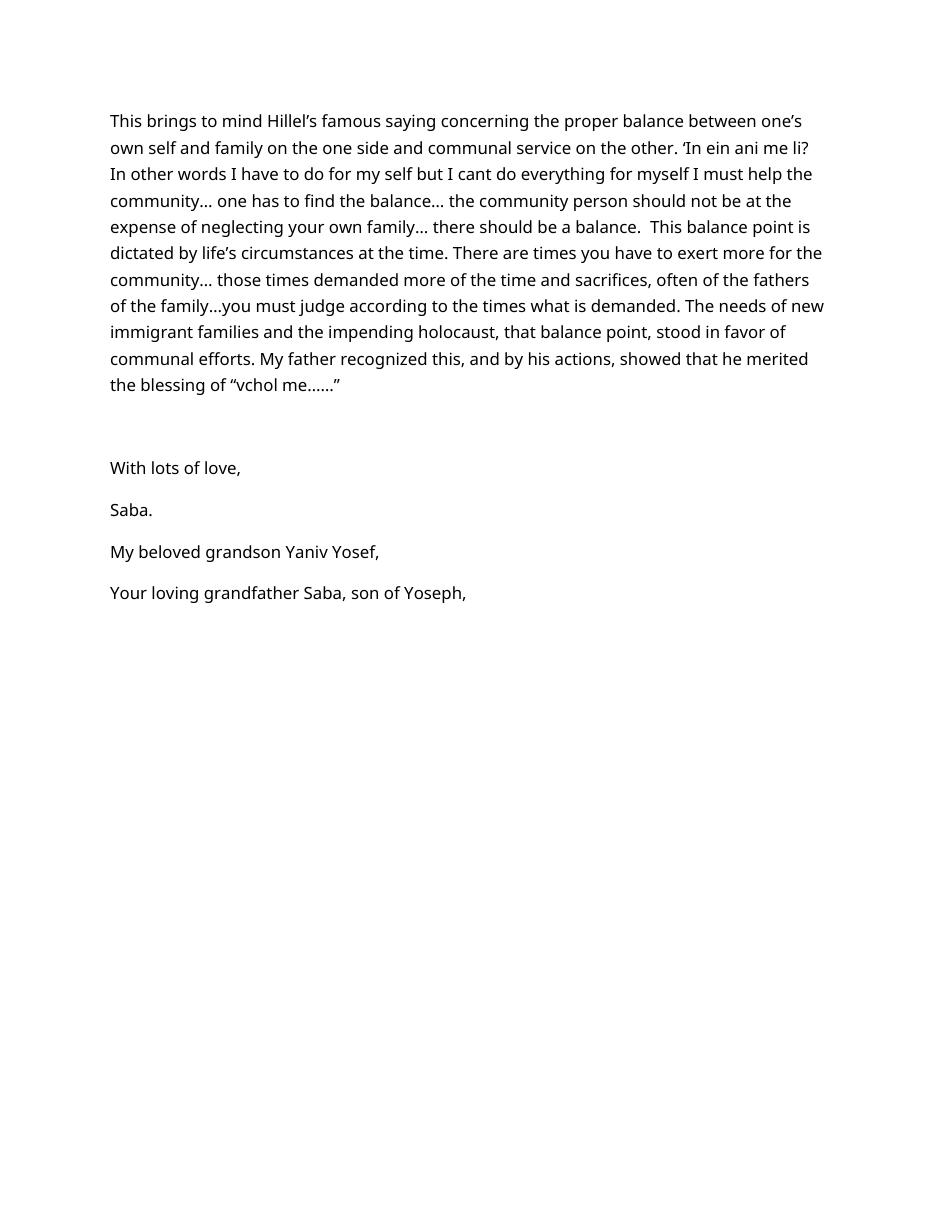
This brings to mind Hillel’s famous saying concerning the proper balance between one’s own self and family on the one side and communal service on the other. ‘In ein ani me li? In other words I have to do for my self but I cant do everything for myself I must help the community… one has to find the balance… the community person should not be at the expense of neglecting your own family… there should be a balance. This balance point is dictated by life’s circumstances at the time. There are times you have to exert more for the community… those times demanded more of the time and sacrifices, often of the fathers of the family…you must judge according to the times what is demanded. The needs of new immigrant families and the impending holocaust, that balance point, stood in favor of communal efforts. My father recognized this, and by his actions, showed that he merited the blessing of “vchol me……”
With lots of love,
Saba.
My beloved grandson Yaniv Yosef,
Your loving grandfather Saba, son of Yoseph,